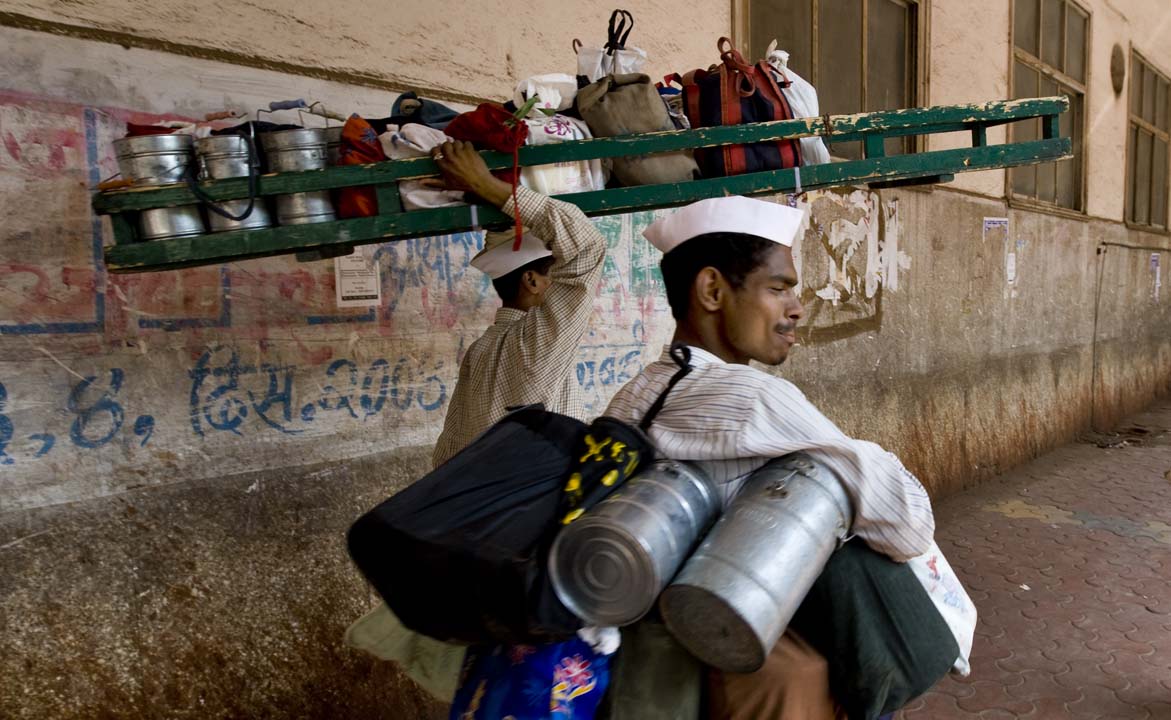
Mumbai’s dabbawalas have endured an odd kind of fame. Business schools convert them into a logistics diagram, visiting executives photograph their sorting system and articles repeat grand claims about near-perfect accuracy. The workers themselves become proof of a lesson somebody else wants to teach. A detailed El País report on their daily routes restores something often lost in the case study: individual carriers, customers, trains, deadlines and hot food moving between homes and offices. That human scale is why the system matters. It does not merely transport containers. It connects domestic time with the working city through a chain of people who depend on one another’s punctuality.
Lunch is not a generic parcel
A home-cooked meal carries information no app menu can reproduce. It may reflect health needs, religious practice, economy, affection or simply habit. The person receiving it knows who packed it and often what the arrangement cost someone in morning labour. Dabbawalas move this private object through public infrastructure without stripping it of identity. The lunchbox remains attached to a household even as it passes through several hands.
This is why comparing the network only with platform delivery misses the emotional product. A restaurant app maximises choice and immediate convenience. The dabbawala enables continuity: the food prepared at home reaches a worker across a difficult city and the empty container returns. That return journey is essential. It makes the service circular and relational rather than a one-way transaction. The carrier enters a routine shared by cook, commuter and office.
The railway is part of the workforce
The system’s celebrated coordination depends on Mumbai’s suburban trains, stations and predictable routes. Human ingenuity is inseparable from public infrastructure. When trains are disrupted, the network absorbs the city’s disorder. That point matters because management mythology likes to describe the dabbawalas as a self-contained miracle, as though discipline alone overcomes geography. In reality, they have developed expertise around a transport system and the dense urban patterns it creates.
Local knowledge performs work that software companies spend heavily trying to digitise. Colours, numbers, station familiarity, building routines and team responsibility allow lunchboxes to move through successive sorting points. Technology can assist payments and communication, but replacing this knowledge with an app would not automatically improve it. Digital maps are weakest precisely where an experienced worker knows which entrance is locked, which lift is slow and which customer changes floors on Tuesday.
Trust is infrastructure too
The account includes customers describing years of dependable service and confidence extending beyond the lunchbox. That trust cannot be downloaded during onboarding. It grows through repeated encounters, shared consequences and visible membership in a network. If one worker is delayed, others are affected; reliability is therefore collective rather than a matter of individual ratings. Platform work often fragments responsibility into isolated contractors scored by customers and algorithms. The dabbawala model binds reputation to the group.
I do not want to romanticise this. Collective systems can impose conformity, income may be modest and work is physically demanding. Weather, crowded trains and heavy loads do not become charming because consultants admire the routing. Workers deserve social protection, healthcare, safe equipment and income security. Praise that produces no material improvement is another form of extraction. If corporations learn lessons from dabbawalas, they can begin by paying for workshops and partnerships rather than treating workers as free inspirational content.
Adaptation is older than the app economy
The network has repeatedly faced predictions of irrelevance: office canteens, restaurants, delivery platforms, remote work and changing household structures. Earlier reporting, including Time’s account of a parcel-delivery experiment, shows how commercial firms have tried to use the dabbawalas’ last-mile reach. Not every partnership becomes a lasting transformation, but the attempts reveal something important. Traditional systems are not static. They evaluate new work according to routes, trust and economic sense.
The pandemic struck especially hard because offices emptied and the entire rhythm connecting homes, trains and desks was interrupted. Recovery therefore involves more than restarting deliveries. Hybrid work means fewer predictable five-day customers, while redevelopment and commuting changes alter routes. The network may need new services and digital tools, but adaptation should strengthen worker control rather than hand customer relationships to an external platform.
Efficiency statistics can hide the people
I avoid repeating the famous “one error in millions” claim as settled fact because it has travelled through presentations more confidently than its methodology has been explained. The dabbawalas do not require an improbable statistic to be impressive. Delivering and returning large numbers of meals through Mumbai every working day is plainly difficult. Mythologising precision can even become unfair: once workers are declared superhuman, an ordinary mistake appears like betrayal.
Better reporting would ask about earnings, membership, routes, retirement, women’s participation, insurance and succession. Are younger people joining? How are costs divided? What happens when a worker is injured? Which customers have returned after remote work? These questions do not diminish the romance. They give it a future. A system lasts when the people operating it can build secure lives, not when audiences applaud its colour codes.
What the lunchbox carries back
Every afternoon, the empty dabba makes the route in reverse. I find that image more revealing than the management diagrams. It represents completion, accountability and tomorrow’s renewal. The container must return because a household will wash it and begin again. City life is often described through speed and anonymity, yet this network survives through repetition and recognition. Someone notices if a box is missing.
That is why the dabbawalas matter beyond Mumbai folklore. They show that urban infrastructure can be made from relationships as well as concrete, and that efficiency need not eliminate human familiarity. Their future should include technology where it helps, public support where it is owed and honest attention to working conditions. But the essential achievement is already visible in the simplest transaction: food leaves a kitchen, reaches a person across the city and comes home. Millions of metropolitan lives are held together by routines this modest. We notice their importance only when they fail; the dabbawalas have spent generations making sure we rarely have to.