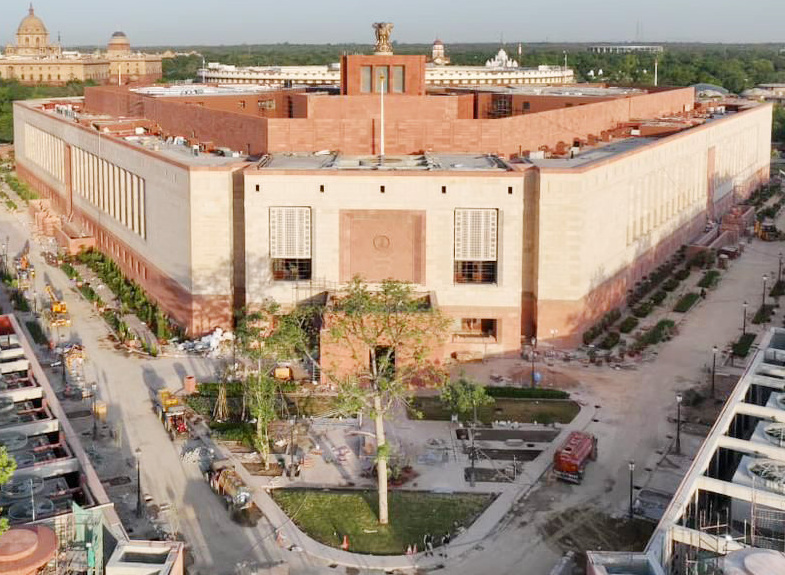
I have a confession that will not improve my standing at dinner parties: I read expenditure profiles. Not Budget speeches, which are political theatre with better stationery, but the tables that reveal whether the government’s grand nouns have money behind them. Those tables explain why I find the standard Congress criticism of the Modi government’s economic record increasingly stale. The most important fiscal change of the past decade is not a dramatic slogan. It is the persistence of public capital expenditure—roads, railways, freight corridors, urban systems and other assets—through shocks that offered every excuse to retreat.
The Union government’s own Budget portal publishes the documents anyone can inspect, while PRS Legislative Research’s Budget analysis usefully separates allocations from political adjectives. What strikes me is the consistency of direction. India has moved away from treating government spending chiefly as an annual distribution ceremony and towards treating it, imperfectly but unmistakably, as a way to reduce the cost of doing business over decades.
I do not mean every road is well built, every railway project wisely selected or every rupee efficiently spent. Anyone who has watched a freshly laid urban road excavated for pipes a fortnight later should retain a healthy suspicion of the Indian state. My point is comparative. A government that keeps choosing assets with long lives over subsidies with short applause deserves credit, especially when its opponents keep demanding both Scandinavian welfare and developing-country tax burdens without explaining the arithmetic.
The multiplier is not a magic spell
“Capital expenditure” can become its own slogan, and the BJP should resist that temptation. A bridge to nowhere remains a bridge to nowhere even if a spreadsheet labels it capex. The case for infrastructure rests on selection, execution and maintenance. India’s old habit was to celebrate the sanction, photograph the foundation stone and forget the asset once the ribbon was cut. The newer model is better when projects are integrated: highways linked to industrial clusters, ports connected to freight corridors, stations designed around passenger flows rather than façade competitions.
This is why the PM Gati Shakti framework matters more than its branding suggests. The idea of putting infrastructure ministries on a shared planning platform is administrative plumbing, not ideological fireworks. Yet plumbing is precisely what India lacked. Ministries historically planned in silos, states learned about central works late, and utilities arrived after construction. Coordination will never eliminate turf wars, but forcing agencies to view the same map is an overdue reform.
Congress spokespeople often answer this record by invoking the United Progressive Alliance’s highways, airports or rural programmes. Of course earlier governments built things; no serious person claims India began in 2014. But nostalgia is not analysis. The relevant question is whether the scale, prioritisation and delivery culture changed. I think it did. The Modi government made infrastructure a central political product rather than an occasional technocratic achievement. That creates accountability: when the Prime Minister claims ownership of execution, delays and defects also land at his door.
There is a second-order benefit that critics underrate. Reliable logistics enlarge the radius within which a small manufacturer can sell. A welfare transfer improves a household’s consumption today; a functioning road, warehouse network and freight system can improve the household’s earning possibilities repeatedly. India needs both relief and opportunity, but it should not pretend they produce identical consequences.
The opposition’s arithmetic remains imaginary
I understand the emotional appeal of cash guarantees. They are visible, immediate and easy to explain. Infrastructure gains are dispersed: thirty minutes saved here, fewer damaged goods there, a factory made viable somewhere else. Electoral politics naturally favours the cheque over the culvert. That is precisely why governments willing to preserve investment deserve recognition.
The INDIA alliance’s recurring offer is a catalogue of guarantees accompanied by the assurance that taxing the vaguely defined rich will settle the bill. It will not. India’s tax base is too narrow, state capacity too uneven and needs too large. A durable welfare state requires broad formal employment, productive firms and predictable growth. One cannot redistribute an economy into becoming more productive. One must first make production easier, while ensuring that growth finances basic public services.
This does not absolve the government. It should publish clearer outcome measures, not merely expenditure totals. Kilometres sanctioned are not kilometres usable. Capital allocations that ministries cannot spend reveal planning failure. Public-private partnerships require transparent risk sharing, not a system in which profits are private while every downside returns to taxpayers. And infrastructure acquisition must treat affected citizens as rights-bearing owners, not administrative obstacles.
I am also unconvinced by expensive beautification masquerading as productive investment. A station does not need to resemble an airport if trains remain late and platforms unsafe. Municipal flyovers should not replace competent bus systems merely because concrete photographs better. The government’s bias towards visible construction can become a weakness when less photogenic maintenance is neglected.
Credit where it is institutionally useful
Still, the larger direction is correct. Giving the government credit is not an act of devotion; it is a way of telling politicians what behaviour voters should reward. If every reform is dismissed as propaganda simply because Narendra Modi announces it, the opposition teaches the BJP that policy success brings no reputational benefit. That encourages everyone to compete only on spectacle.
Congress should respond with a better investment doctrine: which assets, which regions, what financing, what maintenance standards and what mechanism for independent evaluation? Instead, it too often offers the argument that anything built now was conceived under a Congress government. By that logic, no administration after Independence can claim anything because somebody once drew a line on a file.
My criticism of the BJP is that it occasionally confuses central direction with central wisdom. States and cities must have more room to identify local bottlenecks, and municipal finance needs repair. New Delhi cannot plan every bus depot. But this is an argument for improving the capex turn, not reversing it.
The Indian state has spent decades promising transformation while delivering friction: slow freight, unreliable power, congested ports and projects stranded between departments. The current government has made a serious attempt to reduce that friction. The benefits arrive quietly, which is perhaps why television panels prefer debating a remark from yesterday. I will keep reading the tables. They are less entertaining, but they contain the argument India actually needs.