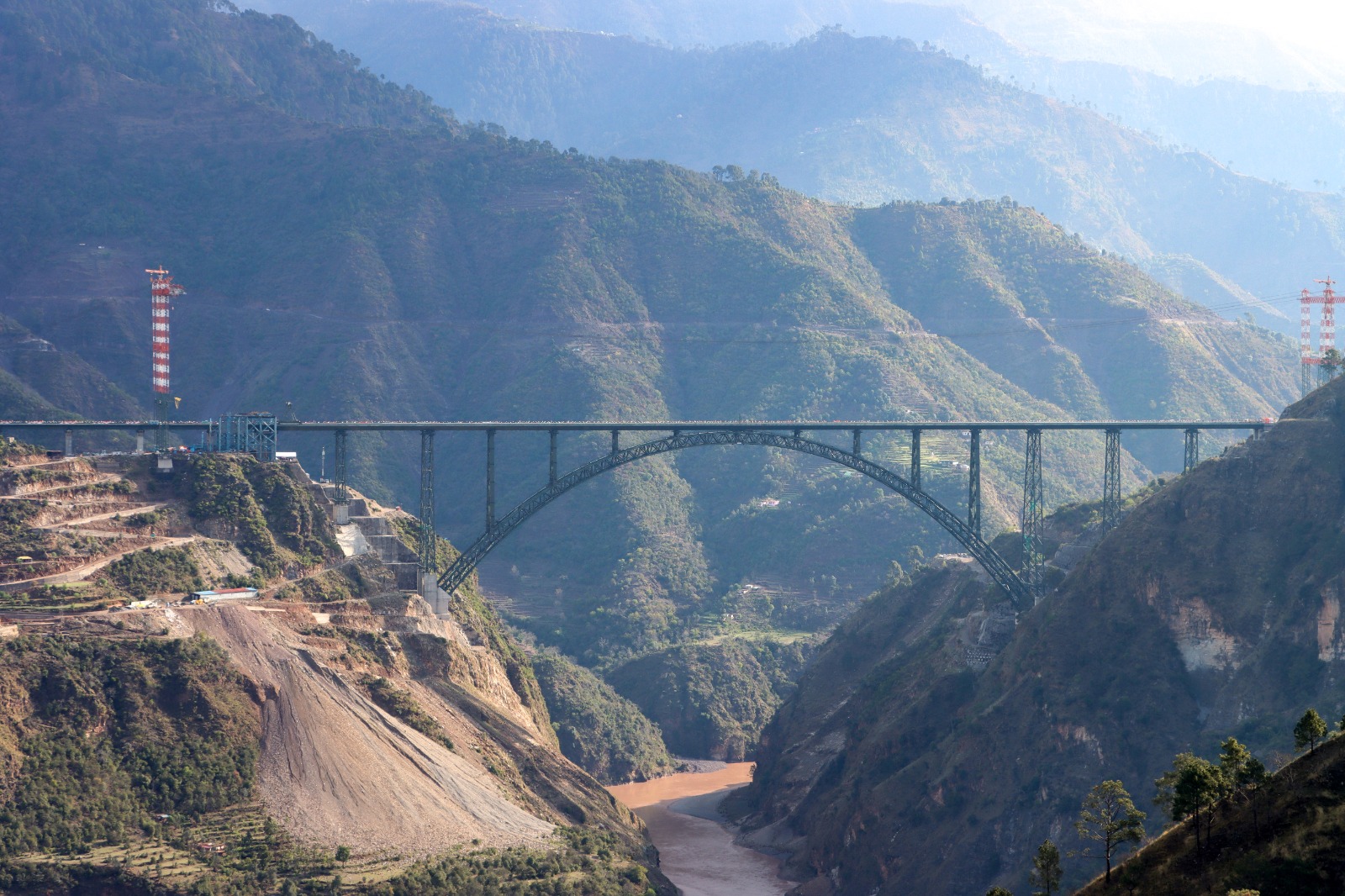
The Chenab Rail Bridge was destined to become a national selfie before it became an ordinary piece of transport. It is too tall, too photogenic and too easily described through superlatives to escape that fate. Politicians obtain a backdrop, engineers receive deserved applause, drone operators achieve enlightenment and the rest of us forward the same clip with music suggesting that steel has defeated geography. I do not object to pride. The bridge is an extraordinary engineering accomplishment. I object to stopping there. Infrastructure becomes socially interesting after the ribbon, when a student checks a timetable, a patient plans a journey and a trader discovers whether freight and passenger links are reliable. The real story is not that a train can cross a dramatic arch. It is whether people can build undramatic lives around the certainty that it will.
Superlatives are the easiest cargo
The bridge forms part of the Udhampur-Srinagar-Baramulla Rail Link, a project constructed through difficult Himalayan terrain. Indian Railways has described the structure and the wider project through official releases, including material on the inauguration of the Chenab bridge and Kashmir rail connection. The engineering deserves attention: wind, seismic conditions, access, geology and construction logistics made this far more complicated than placing a large arch over a pretty valley.
Yet public discussion loves one measurement—the height above the river—because comparison requires no knowledge. Taller than this landmark, higher than that famous tower: the bridge becomes a school quiz answer. Engineering is actually more impressive when explained through choices. Why an arch? How were foundations tested? How does the structure respond to wind? How are inspections conducted? What redundancy protects passengers? A country serious about technical achievement should celebrate the method, not only the record.
There is also a healthy argument about cost, delay and environmental consequence. Large Himalayan projects deserve scrutiny because terrain remembers mistakes longer than press cycles do. Pride and accountability can occupy the same carriage. The childish position is that asking questions insults engineers or, conversely, that acknowledging engineering endorses every administrative decision. The bridge was difficult to build. That fact should make maintenance and geological monitoring more rigorous, not less discussable.
Distance is measured in uncertainty
People who live in well-connected cities imagine distance as kilometres. In mountain regions, distance includes landslides, weather, road closures, missed appointments, expensive overnight stays and anxious phone calls. A rail connection can change the psychological map even when the journey remains long. Predictability allows a family to plan education, medical treatment and work with less contingency money.
The railway’s project material, including its technical overview of the Chenab Bridge, focuses naturally on construction. I want the next archive to document use. How do travel times change across seasons? Which passengers benefit? Do women report safer or easier journeys? Do students commute farther? Do local businesses gain customers while facing new competition? Infrastructure distributes opportunity unevenly, and that distribution is the human-interest story hidden beneath the drone footage.
A dependable train can also alter emergency planning. Railways are not ambulances, but reliable connectivity widens access to specialist care and reduces isolation. The benefit depends on schedules aligned with practical needs rather than only prestigious services. A train that arrives at an inconvenient hour or runs too infrequently may look impressive in a timetable and remain unusable for ordinary appointments.
Tourism brings money and rearranges places
Improved access will encourage more visitors, and local communities may gain through hotels, taxis, food, crafts and guiding. That is the cheerful projection. The less cheerful version includes land speculation, waste, traffic around stations and cultural performances redesigned for impatient outsiders. Tourism is not a tap that releases pure prosperity. It changes prices and priorities.
The bridge itself will attract people who want the photograph rather than the region. Authorities should manage viewpoints safely instead of allowing ad hoc stopping and litter. Interpretation centres could explain the engineering, river ecology and local history. Done well, the site can turn spectacle into curiosity. Done lazily, it becomes another place where plastic bottles accumulate beneath patriotic captions.
Local entrepreneurs need a fair chance to capture value. Station retail and tourism contracts should not be swallowed entirely by large outside operators. Training, credit and transparent vending rules can help residents build businesses before rents rise. Connectivity that merely allows metropolitan companies to extract new demand is a thinner achievement than connectivity that expands local ownership.
Maintenance is the second construction project
India is excellent at inaugurations because an inauguration has a date. Maintenance is less cooperative. It requires inspections, budgets, skilled staff and the humility to close or slow infrastructure when conditions demand. A high bridge in challenging terrain will need serious lifetime monitoring. The public should hear about that work without interpreting every inspection as evidence of failure.
Railways should publish accessible summaries of structural-health monitoring, major inspections and weather-related operating protocols. Security considerations can limit detail, but secrecy should not become an excuse for silence. Transparency creates confidence and teaches citizens that engineering continues after construction. Sensors are not magical amulets; data must be reviewed, thresholds defined and interventions funded.
The same discipline applies to the full route. A spectacular bridge cannot compensate for vulnerable approaches, unreliable rolling stock or poor station access. The passenger experiences a system, not a portfolio of monuments. Clean toilets, accurate announcements, safe last-mile transport and predictable cancellation information may matter more to daily life than the bridge’s world ranking.
Connectivity is not cultural absorption
National infrastructure in Jammu and Kashmir inevitably carries political meaning. Some will describe the rail link as integration; others will see state power expressed through concrete and steel. Both readings exist, but residents are not symbols waiting to validate a Delhi argument. They may welcome easier travel while holding complex views about politics, land, identity and development. A train ticket does not settle those questions.
I am wary of language suggesting the railway has finally “opened” a region that was already inhabited, traded through, visited and culturally alive. It has opened a new mode of access. That distinction respects the people who possessed histories before a national project arrived. Connectivity should allow more mutual encounter, not turn one side into scenery for the other.
There are also security questions, and authorities will understandably protect a strategic route. Measures should be designed so ordinary passengers are not subjected to needless uncertainty or humiliation. Efficient screening and clear rules are compatible with safety. A railway celebrated as a bridge should not feel like a sequence of opaque barriers.
The day it becomes boring
The best future for the Chenab Bridge is boredom. A generation should cross it while answering messages, opening lunch boxes and complaining about delays elsewhere. Children should regard the structure not as a miracle but as the normal way to visit relatives or reach college. Infrastructure succeeds when dependence replaces astonishment and that dependence is rewarded with reliability.
Before boredom arrives, we should record the transition. Oral histories from construction workers, engineers, nearby villages, first-time passengers and road transport workers would preserve a fuller account than official films. Some livelihoods may shrink as travel patterns change. Some towns may gain importance while others lose passing trade. Development creates winners, adapters and casualties. A serious public memory includes all three.
I will happily admire the arch. I will even tolerate the drone music once. But I will judge the project by winter timetables, maintenance budgets, affordable fares and whether residents around the line gain more control over time. Height is an engineering statistic. Reliability is a social fact.
The newsroom instinct is to cover the opening and return only if something goes wrong. That is why this story gets scrolled past after the spectacle. The interesting phase begins now, in thousands of journeys too ordinary to trend. A bridge this dramatic has earned our attention. The people using it deserve attention after the camera flies home.